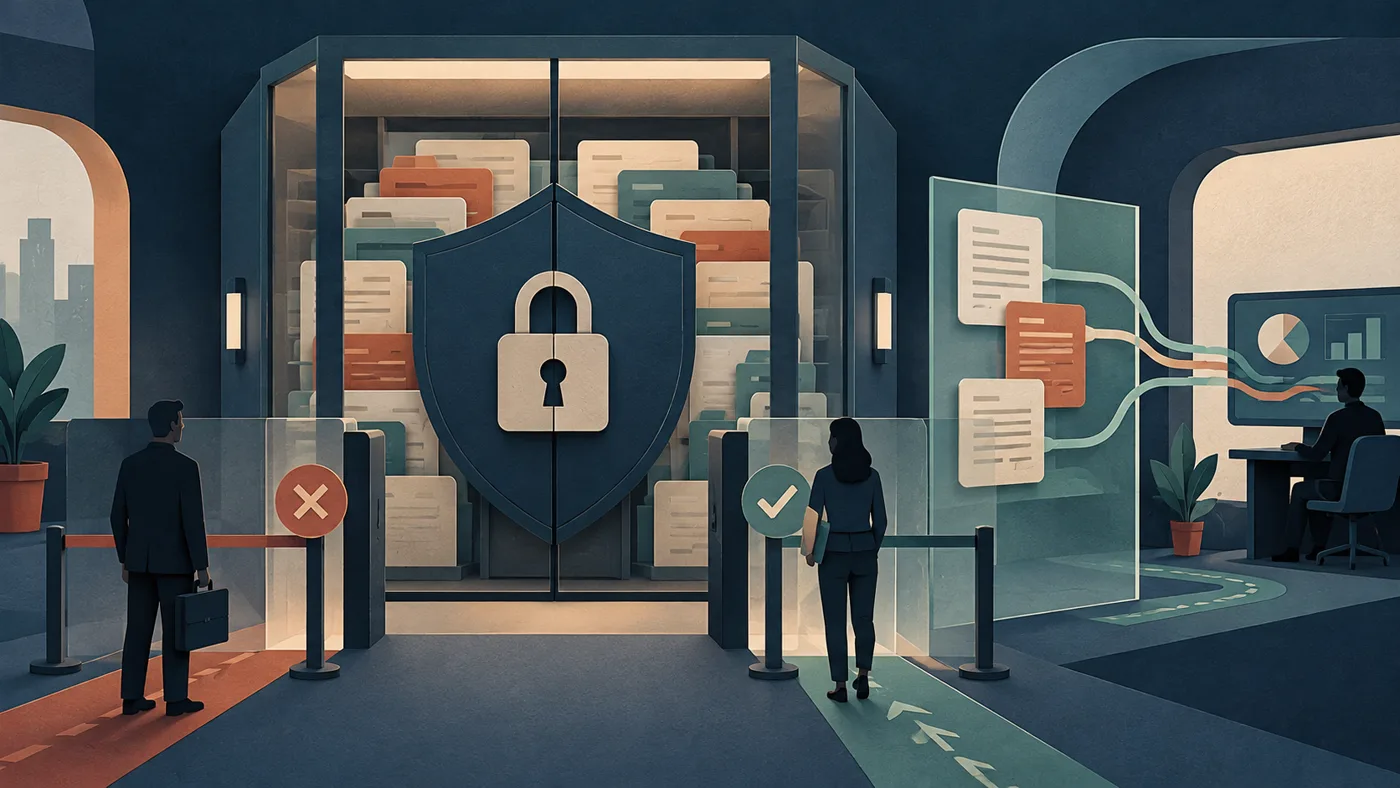
Privacy is a data-flow decision
NIST's Privacy Framework is useful because it keeps the work tied to purpose, control, communication, and risk rather than a single vendor setting.
Map the smallest useful data path
Write the workflow's purpose and the minimum fields it needs. A meeting follow-up may need the decision, owner, date, and record ID, not the entire transcript or every participant's personal details. A support classification may need a ticket body, not a full customer export.
Minimization reduces exposure, cost, and the number of places a correction must reach.
Verify vendor controls in context
Check whether inputs are used for training, how long they are retained, where they are processed, who can access logs, how deletion works, and what administrators can configure. OpenAI and Microsoft publish current privacy and assurance material, but the relevant answer still depends on the product and contract you use.
Keep permissions and retention aligned
A user should not be able to send more data to a model than they are allowed to read. Derived answers and logs need their own retention and access rules. If a workflow creates a CRM note, decide whether that note becomes part of the authoritative customer record and how corrections are handled.
Avoid compliance theater
Document the actual controls and the remaining uncertainty. Do not claim GDPR, HIPAA, SOC 2, or industry compliance merely because a vendor uses those words. Ask the responsible privacy, security, and legal owners to assess the use case.
The Business Brain can help route approved context, but it does not remove the organization's accountability for data use.
Classify data before connecting a source
Mark the purpose, sensitivity, owner, permitted audience, retention period, and approved processing path for each field. A workflow may need an account ID and decision date while having no reason to send a full transcript or personal contact list. Redaction and field-level filtering should happen before model processing where possible.
The data map should include prompts, retrieval indexes, caches, logs, evaluations, exports, and downstream records. Each derived copy is another place where access and deletion must work.
Plan retention and incident response
Verify current vendor terms and workspace settings for training use, retention, regional processing, administrative access, deletion, and subprocessors. Keep the result tied to the exact product and account, not to a generic vendor statement.
Define what happens when data is sent to the wrong audience or retained longer than intended. The response should identify the affected source, revoke access, correct derived stores, notify the responsible owner, and preserve only the evidence required for the incident process.
The LeanOrchestr Business Brain connects approved company sources, preserves access boundaries, and turns useful context into a maintained operating layer. Start with one question, one accountable owner, and an evaluation set you can rerun.
Sources and verification
Primary product, architecture, risk, and security sources checked on 10 September 2026. Product behavior can change, so verify current plan and admin documentation before implementation.