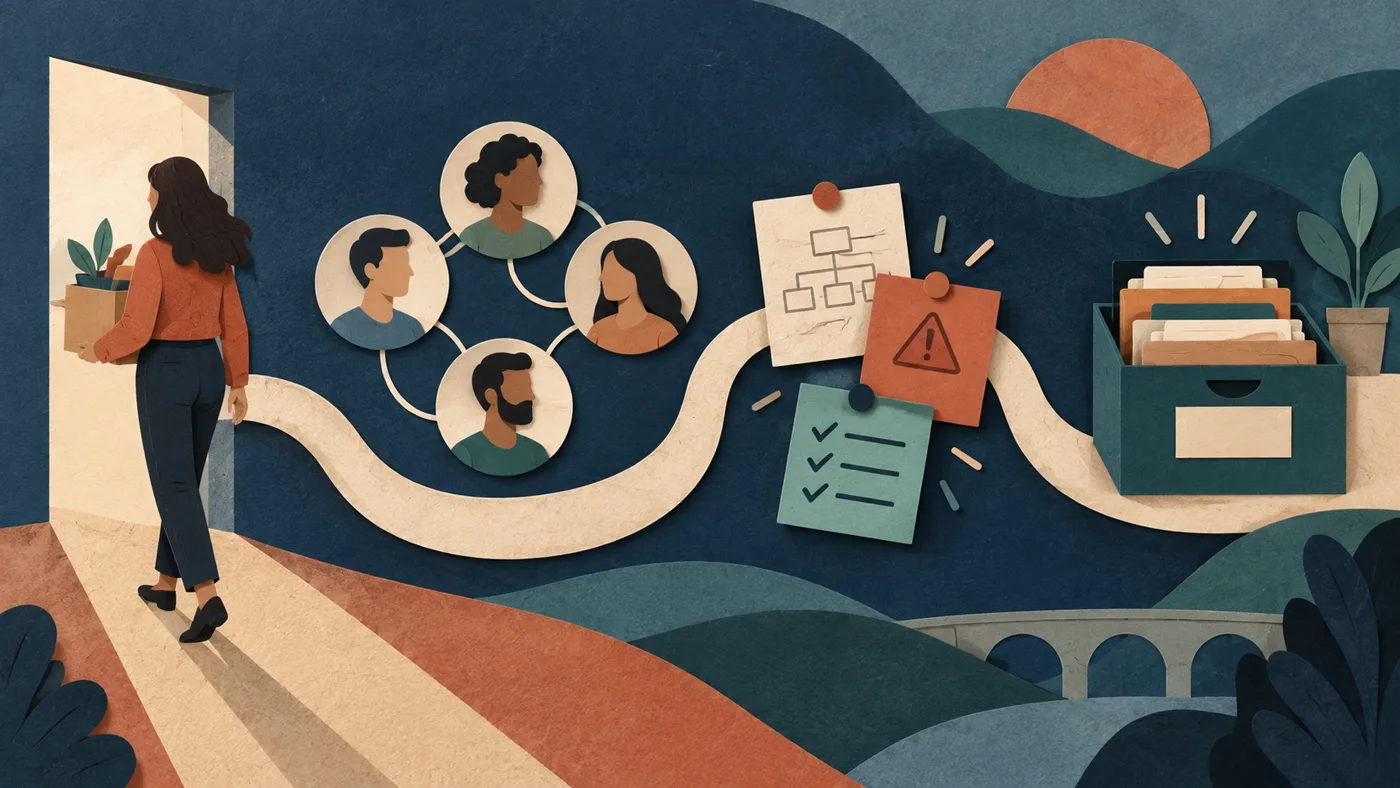
The last afternoon is too late
Continuity is stronger when capture happens during normal work and the final handover assembles a current view from the records that already exist.
Capture the work around the record
For each active customer, project, or responsibility, record current state, next commitment, decision history, open risk, key relationships, source links, and the person who can make the next decision. Include what is unusual, not only the standard procedure.
A CRM stage or task status is a starting point. The useful context may live in meeting notes, messages, approvals, and the reason a workaround was chosen.
Make exceptions explicit
Experienced employees often carry unwritten rules: which customer needs a different handoff, which supplier requires an early call, which report number is provisional, or which policy has an approved exception. Ask for examples and link each one to evidence and an owner.
Do not turn a private memory into a universal policy without review. The handover should distinguish current practice, historical context, and proposed change.
Use a guided handover session
A practical session walks through live work, decisions, risks, relationships, and unanswered questions. The successor attempts a small task while the expert explains how to verify the result. Capture corrections in the source system when possible.
A Business Brain can assemble the brief, but the human conversation still resolves ambiguity and trust. Automation should reduce reconstruction work, not erase judgment.
Test the successor path
Read the handover as a person who lacks the departing employee's context. Can they find the current owner, source, deadline, exception, and next action? Can they tell what is unknown? Test one real workflow and record the gaps.
Ready.gov's continuity guidance treats continuity as an operating capability. The same idea applies to knowledge: a document is not complete until work can continue.
Build the handover packet from live work
For each active responsibility, assemble current state, next commitment, decision history, open risks, relationships, source links, exceptions, and accountable owners. Ask the employee to correct the assembled view instead of starting from a blank document.
Keep sensitive personal information out unless it is necessary and approved. Distinguish a current rule from a historical reason and from a suggestion for the successor. That separation prevents a workaround from becoming an accidental policy.
Test the successor path before the final day
Have the successor complete a representative task using the packet and approved systems. Record every question that still requires the departing employee, then repair the source, ownership, or procedure. A meeting transcript alone is not a handover if nobody can find the next action.
Schedule a short follow-up after the transition. New questions show which tacit relationships or exceptions were missed and should become maintained company knowledge.
The LeanOrchestr Business Brain connects approved company sources, preserves access boundaries, and turns useful context into a maintained operating layer. Start with one question, one accountable owner, and an evaluation set you can rerun.
Sources and verification
Primary product, architecture, risk, and security sources checked on 10 September 2026. Product behavior can change, so verify current plan and admin documentation before implementation.